


Four main factors affecting cassava production in Nigeria
11-19,2018 / Industry news / Chat online / Leave a message
- TEL:
- WhatsApp:
- Email:
sales@doingmachinery.com
According to the Nigerian Business Daily, the Nigerian government plans to transform from a single oil economy to a diversified economy. Nigeria's cassava production ranks first in the world, and the development of this advantageous resource is one of the government's strategic plans. However, there are still many shortcomings in the basic conditions factors affecting cassava production in Nigeria.
 Cassava starch
First, the cassava variety needs to be improved. At present, the commercial development value of Nigerian cassava varieties is low which is one of the factors affecting cassava production in Nigeria. The content of cassava starch planted in Nigeria is generally low. If it can be improved by varieties, it can reach the level of 38-40% of cassava starch in India and Malaysia, and its commercial development value can be seen.
Second, the cost of agricultural materials is high. The high cost of agricultural materials not only affecting the level of cassava yield, but also the important factors affecting cassava production in Nigeria. In the growing season of cassava, the control of weeds is not in place, and it is basically in a state of natural growth. The cost of agricultural materials such as pesticides is too high, which affects the enthusiasm of farmers for large-scale production. At present, the output of cassava per hectare is 10.6~15 tons, which requires the government to provide certain subsidies to further increases the productivity.
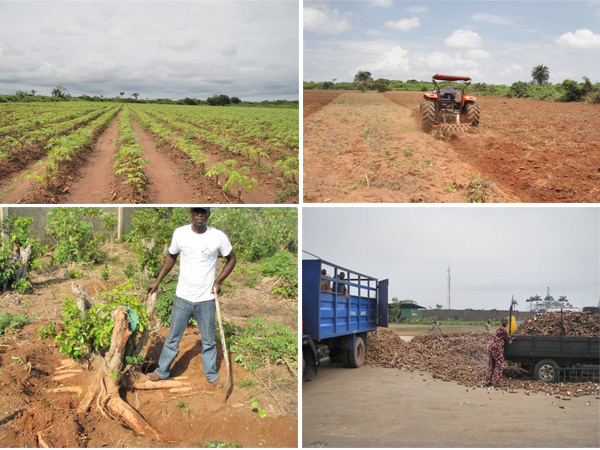 Cassava production in Nigeria
Third, the cassava production in Nigeria lacks the correct value orientation. And this is one of the key factors affecting cassava production in Nigeria. The positioning of the cassava production in Nigeria is still oriented to local basic consumption and as a staple food substitute. There is no commercial development and export-oriented production target, and no refined cassava starch processing technology and financial support are carried out. Cassava can be processed into industrial starch, alcohol, syrup, sweeteners, animal feed, and tapioca beer. The above-mentioned by-product development has success stories in many countries in Africa. At present, the international market price of industrial starch is 200,000 N per ton, and the annual output of cassava is 46 million tons. If cassava can enter the fine starch processing stage, the industrial value chain of cassava production in Nigeria can be reflected. According to incomplete statistics, Nigeria imports 580 million US dollars of cassava by-products every year, therefore the development of cassava resources is also promising for local demand.
 Cassava production machine
Fourth, the lack of basic storage and processing facilities. The lack of advanced cassava starch equipment for cassava production in Nigeria lead to the high loss rate of cassava production and processing. And this is the fourth factors affecting cassava production in Nigeria. Although the workload of cassava production management is much smaller than that of other food crops, due to the lack of warehousing and processing facilities, the high loss rate of cassava production, and the high transportation cost caused by various factors, it takes time to construct the industry value chain for cassava production in Nigeria.
Cassava accounts for about 10 per cent of the world's annual trade, which mainly includes dry chips, granules and cassava starch. Among them, cassava starch is one of the main raw materials in industry. For example, in the fermentation industry, cassava starch can be made into alcohol, citric acid, glutamic acid, etc. And these products can be used in food, beverage, medicine, textile and other industries. At the same time, cassava is also an important energy plant with great potential for development and one of the important pillars for the development of biomass energy industry. Only solve these factors affecting cassava production in Nigeria, Nigeria can improve its cassava processing capacity to cope with the growing global market.
contact us
Want to know more about our products or services? Fill out the contact form below, and we’ll to get back to you and you will get the price list. Please also feel free to contact us by email or phone.( * Denotes a required field).
- Do you want to buy machine?
- Yes, I want to buy machine
- No, I want to learn more in advance.
- What is your raw material?
- Cassava
- Potato
- Sweet potato
- Other:
- What is the final product you want to produce?
- Chips
- Flour
- Starch
- What is the final product you want to produce?
- Garri
- Cassava flour
- Cassava starch
- Cassava chips
- Attiekie
- Bammy
- Other:
- What is your planned capacity for final product?
- <1 ton per day
- 1 ton per day
- 2 tons per day
- 3 tons per day
- 3-10 tons per da
- 10-20 tons per day
- >20 tons per day
- What is the usage of your cassava chips?
- Food usage (like fried chips, flour)
- Industrial usage (like animal feeds, ethanol)
- What is your planned capacity for final product?
- <5 ton per hour
- 5-10 tons per hour
- >10 tons per hour
- What is your planned capacity for final product?
- <500 kg per hour
- 0.5-5 ton per hour
- 5-10 ton per hour
- >10 ton per hour
- What is your planned capacity for final product?
- <300 kg per hour
- 300-1000 kg per hour
- 1-5 ton per hour
- 5-10 ton per hour
- >10 ton per hour

 Call us
 Chat online


